PhysHMR: Learning Humanoid Control Policies from Vision for Physically Plausible Human Motion Reconstruction

University of Pennsylvania
SIGGRAPH Asia 2025 (Conference Papers)

TL;DR: PhysHMR learns a visual-to-action policy that takes image features as the task state and drives a humanoid controller to reproduce human motions in a physics-based simulator.

Teaser Image

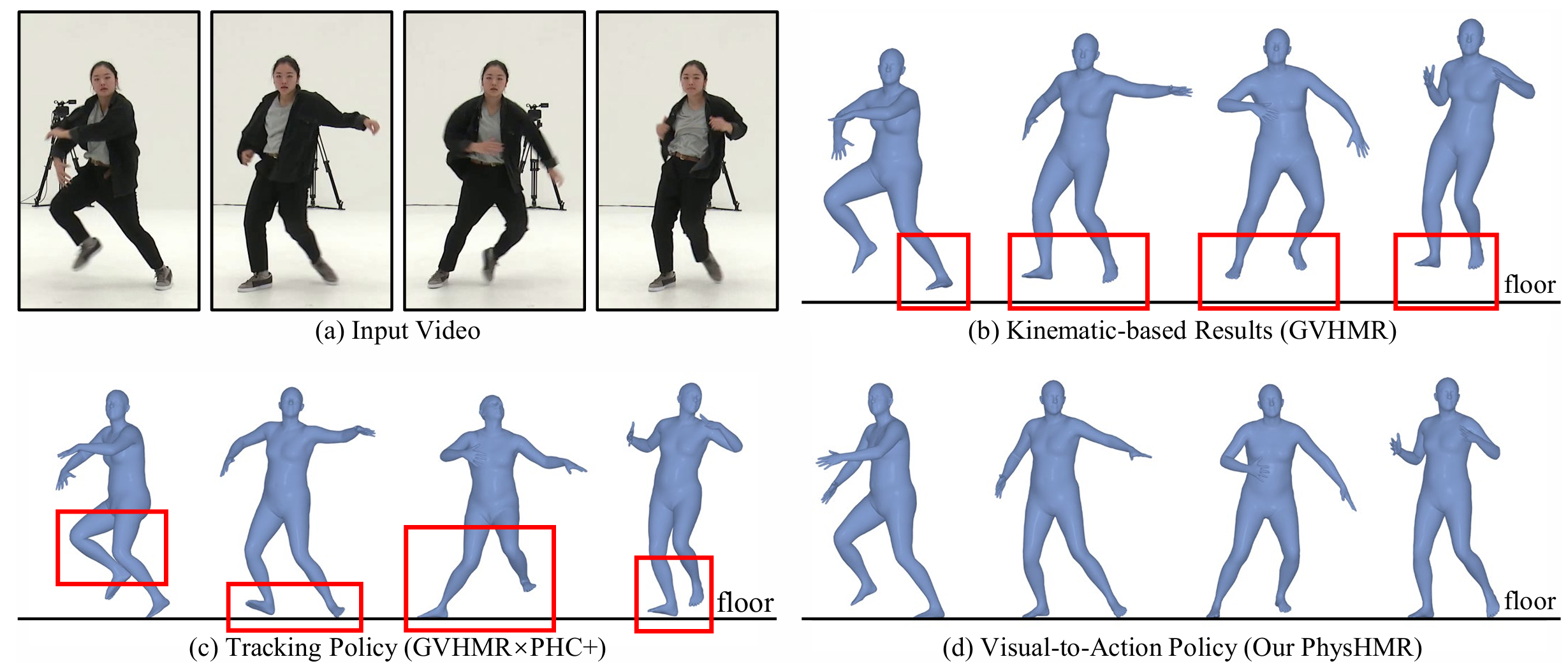
Given a monocular video (a), (b) kinematic-based methods (e.g., GVHMR) often produce artifacts such as foot floating and lack physical plausibility. (c) Tracking-based controllers (e.g., PHC+) enforce physical plausibility but may amplify reconstruction errors, leading to unnatural motion. (d) In contrast, our PhysHMR model directly predicts control signals from visual input, avoiding error amplification and producing motions that are both physically plausible and visually aligned with the input (a).

Abstract

Reconstructing physically plausible human motion from monocular videos remains a challenging problem in computer vision and graphics. Existing methods primarily focus on kinematics-based pose estimation, often leading to unrealistic results due to the lack of physical constraints. To address such artifacts, prior methods have typically relied on physics-based post-processing following the initial kinematics-based motion estimation. However, this two-stage design introduces error accumulation, ultimately limiting the overall reconstruction quality. In this paper, we present PhysHMR, a unified framework that directly learns a visual-to-action policy for humanoid control in a physics-based simulator, enabling motion reconstruction that is both physically grounded and visually aligned with the input video. A key component of our approach is the pixel-as-ray strategy, which lifts 2D keypoints into 3D spatial rays and transforms them into global space, providing robust global pose guidance without depending on noisy 3D root predictions. This soft global grounding, combined with local visual features from a pretrained encoder, allows the policy to reason over both detailed pose and global positioning. To overcome the sample inefficiency of reinforcement learning, we further introduce a distillation scheme that transfers motion knowledge from a mocap-trained expert to the vision-conditioned policy, which is then refined using physically motivated reinforcement learning rewards. Extensive experiments demonstrate that PhysHMR produces high-fidelity, physically plausible motion across diverse scenarios, outperforming prior approaches in both visual accuracy and physical realism.
Method

PhysHMR pipeline

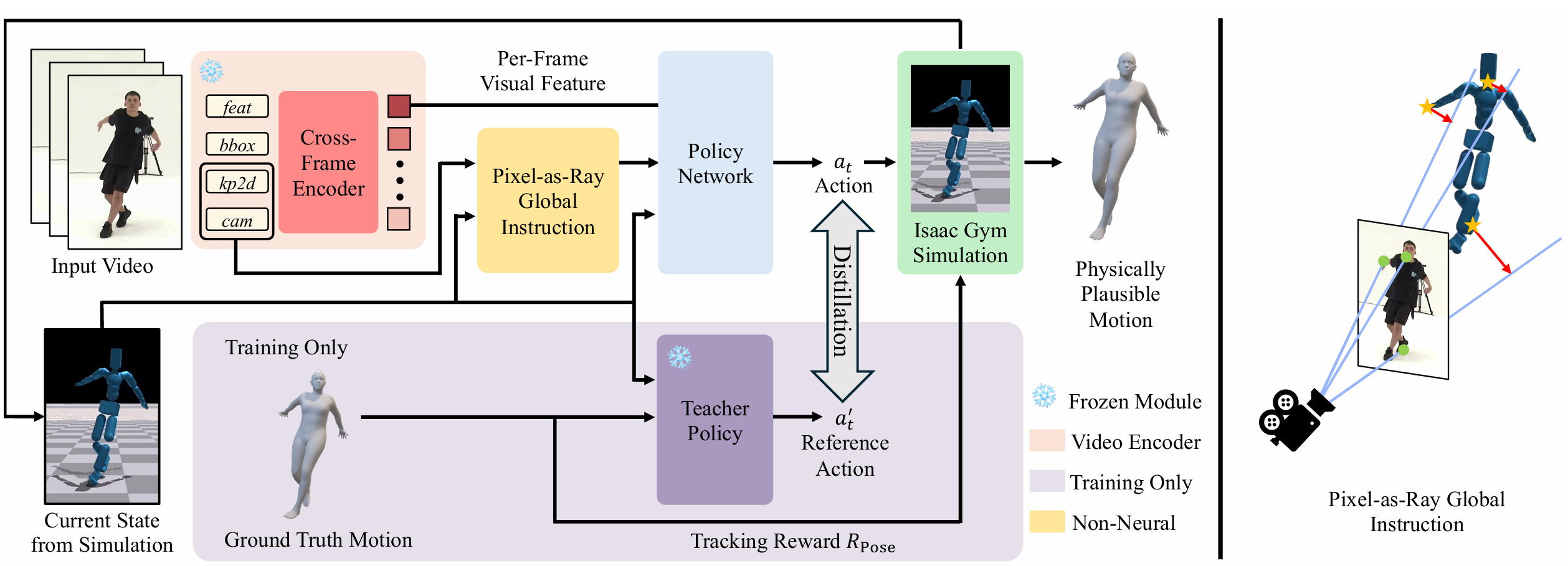
Overview of the PhysHMR pipeline. A visual-to-action policy reconstructs physically plausible motion from monocular videos, with training efficiency improved by combining reinforcement learning and knowledge distillation.

01

Local Reference from Vision

A pretrained video encoder aggregates per-frame image features, bounding boxes, 2D keypoints, and relative camera rotations into root-invariant motion features. Unlike explicit pose reconstructions that commit to a single, potentially inaccurate estimate, these features retain rich pose information without collapsing to a deterministic pose.

02

Global Guidance via Pixel-as-Ray

Instead of relying on noisy 3D root predictions, detected 2D keypoints are back-projected into 3D viewing rays and transformed into world space. The policy observes the displacement from each humanoid joint to its corresponding ray, providing soft global grounding that keeps the motion globally consistent.

03

Distillation + Reinforcement Learning

A mocap-trained expert tracking policy supervises the vision-conditioned policy through action distillation, which is jointly optimized with PPO under imitation, adversarial motion prior, and energy rewards. This combination accelerates convergence and yields more accurate, robust control than either signal alone.


Qualitative Results

Supplementary video with side-by-side comparisons against kinematic and tracking-based baselines.

BibTeX

@inproceedings{feng2025physhmr,
  author    = {Feng, Qiao and Huang, Yiming and Wang, Yufu and Gu, Jiatao and Liu, Lingjie},
  title     = {PhysHMR: Learning Humanoid Control Policies from Vision for Physically Plausible Human Motion Reconstruction},
  booktitle = {SIGGRAPH Asia 2025 Conference Papers (SA Conference Papers '25)},
  year      = {2025},
  publisher = {Association for Computing Machinery},
  address   = {New York, NY, USA},
  doi       = {10.1145/3757377.3763951}
}